The challenge
15+
Distribution depots
600+
30+
Customer locations
Different packaging types
2000+
Different car parts
Optimizing routing and inventory under uncertainty across Europe
Context and Problem
A major European car manufacturer faced a significant challenge in managing their packaging return logistics. Like all automotive companies, they need thousands of different car parts transported from suppliers across Europe to their assembly plants. To protect delicate components and reduce waste, they use reusable packaging that must be returned empty to suppliers after being emptied at the plants.
This creates a complex daily decision-making problem: how to efficiently plan the delivery routes of empty packaging to hundreds of suppliers spread across a continent?
The Scale of the Challenge
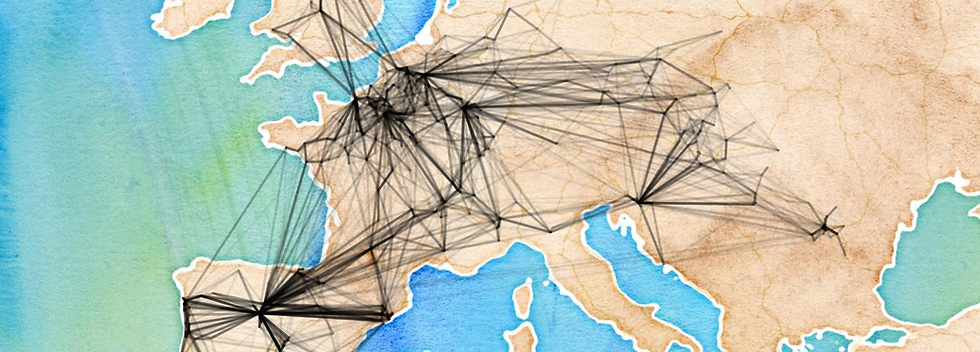
The logistics network spans:
-
15+ distribution depots (assembly plants)
-
600+ customer locations (suppliers) across Europe
-
30+ different packaging types that need to be managed simultaneously
-
Decisions made every single day about which routes to execute
What Makes This Problem Difficult?
Unlike traditional delivery planning, this problem involves several unique complexities:
-
Time-continuous routes: Vehicles travel across Europe on multi-day routes. Changing the order of stops affects when each supplier receives their packaging, which impacts their inventory levels days later.
-
Uncertainty everywhere: Both the demand for empty packaging at suppliers and the release of empty packaging at plants are uncertain and revealed progressively over time.
-
Flexibility creates complexity: Since many packaging types can be used by multiple suppliers, there's an opportunity to return packaging to nearby suppliers rather than sending it back to the original sender. This flexibility can save significant transportation costs and emissions, but makes planning exponentially more difficult.
Our Approach: Merging Operations Research and Machine Learning
Traditional optimization methods couldn't handle the scale and complexity of this problem. Solving it required combining two powerful technologies: machine learning for prediction and operations research for decision-making.
Machine Learning: Understanding Demand and Uncertainty
We use machine learning models to predict packaging needs by analyzing historical data and real-time information from the manufacturing system. These forecasts help anticipate demand at suppliers and packaging availability at plants, while also quantifying the uncertainty in these predictions.
Operations Research: Navigating the Massive Decision Space
With reliable forecasts in hand, we still face an enormous decision space: which suppliers to visit, which routes to follow, how much of each packaging type to deliver, and when.
We developed advanced optimization algorithms that efficiently explore millions of possible solutions, balancing routing costs, inventory levels, and service quality. The system handles problems at a scale that traditional methods cannot solve.
Measurable Impact and Production Deployment
Since 2023, part of our approach has been running daily in production, making real routing decisions that affect actual operations. Over the two following years, the estimated gains are in the order of magnitude of €1 million in cost savings and 1 kiloton of CO₂ emissions avoided.
Why This Matters
Beyond the immediate savings, this project demonstrates how advanced analytics can transform traditional logistics operations. The combination of machine learning and optimization enables companies to:
-
Make better decisions faster than human planners could alone
-
Adapt quickly to changing conditions
-
Achieve both economic and environmental benefits simultaneously
The impact
€1 million
Savings per year
1 kiloton
CO₂ emissions avoided per year